Back to School at Lincoln – La Lucila, Buenos Aires


Lincoln Collage

Collage painting by Ines, a Senior art student at Lincoln

I suppose not everyone waits 33 years to return to their high school, but I did.

It didn’t start out well as I arrived 30 minutes late having taken the train and gone on a detour created by an ill-informed and inaccurate memory map.  But Mrs. Sicotte seemed glad to have me there for a critique of several advanced students, so I was spared the “glad you could join us today” from Mr/s. (put your high school teacher’s name here) that I would have gotten in another era. The first thing I thought when I looked at their artwork was that I wasn’t this good when I was their age….

It’s good to go back to your old high school and see how much things have improved!

door

Entryway to the old high school

I photographed this entry many times and it was featured in the yearbook. Back then the sunlight would stream through the wrought iron door grate and create a magical play of light and shadow on the floor. I wasn’t patient enough this time to wait around for the light.

entryway

...the old high school entrance to "the mansion"

The new entry to the high school

balcony

...a balcony we used to hang out on...

tile

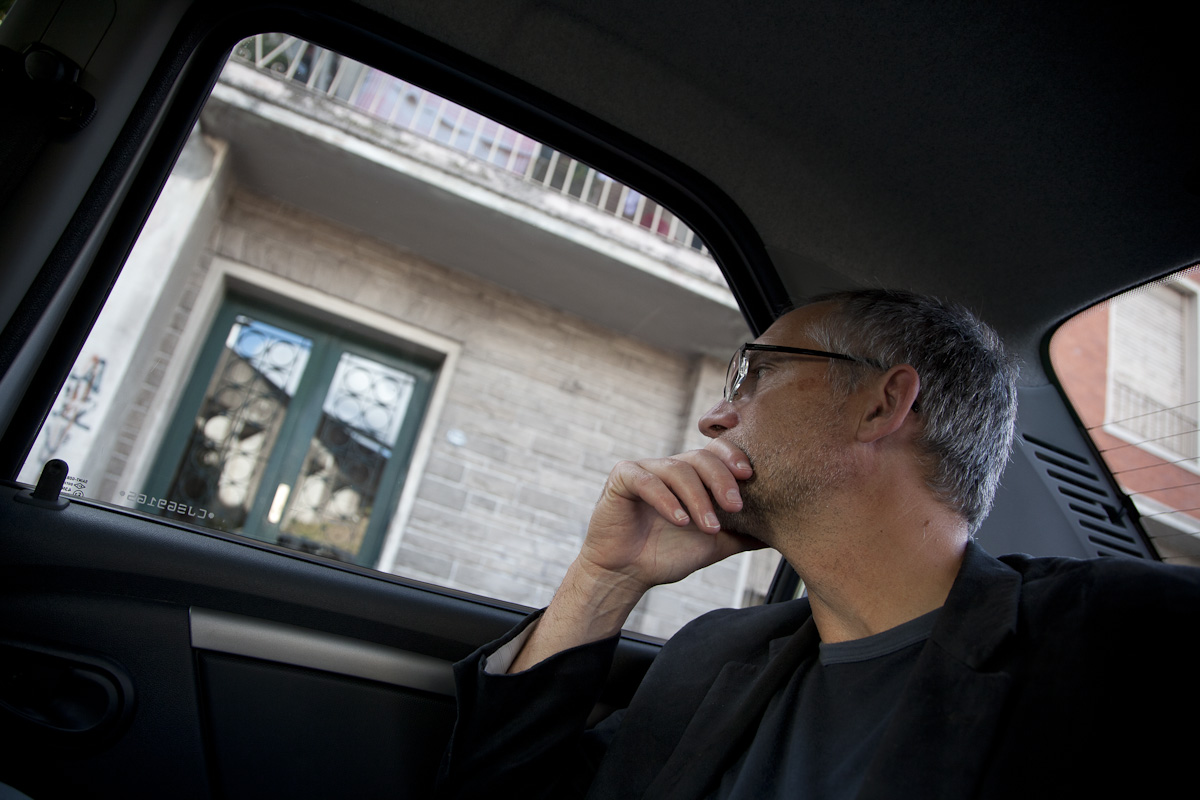
I walked the old neighborhood in-between presentation sessions. The cars were newer, the streets were dirtier…

Presentation in the Magna Auditorium - thanks for the photos, Peter!

There were a lot of questions about how to get into art school and what to put into a portfolio. It reminded me how mysterious and obtuse the realities of higher education seem at that age.

There was lots of discussion about the differences between digital and silver photography and how digital tools impact an artist’s approach and practice.

It was a great experience and I think I was helpful to the students. Thanks for the Lincoln coffee mug – my coffee tasted better this morning!

Download presentation in PDF format

It was a long day. I didn’t get back until 11pm, because I also gave a presentation to the faculty at the Escuela Argentina de Fotografía on learning-centered teaching and online learning. The irony – I didn’t manage to get any photographs of that event!

Posted in Fine Art Photography, Uncategorized | Tagged , , , | 4 Comments

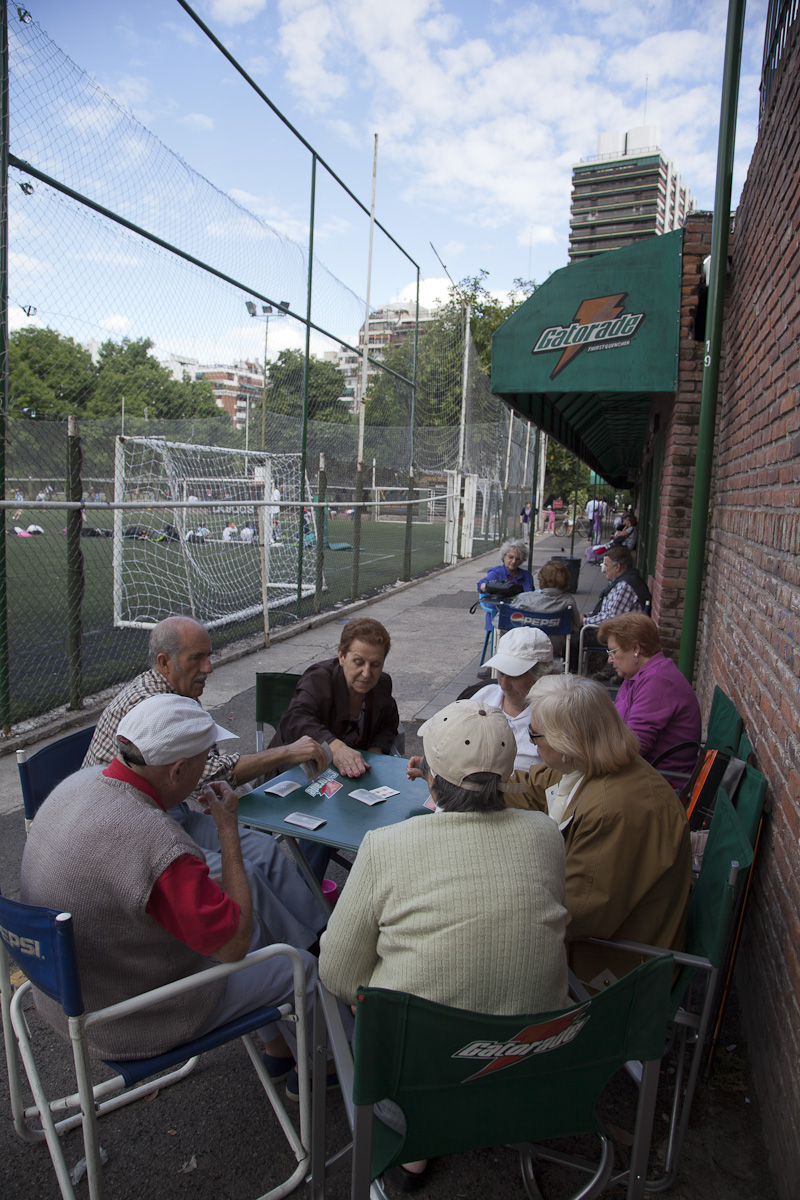
Palermo, Buenos Aires – Parque Las Heras


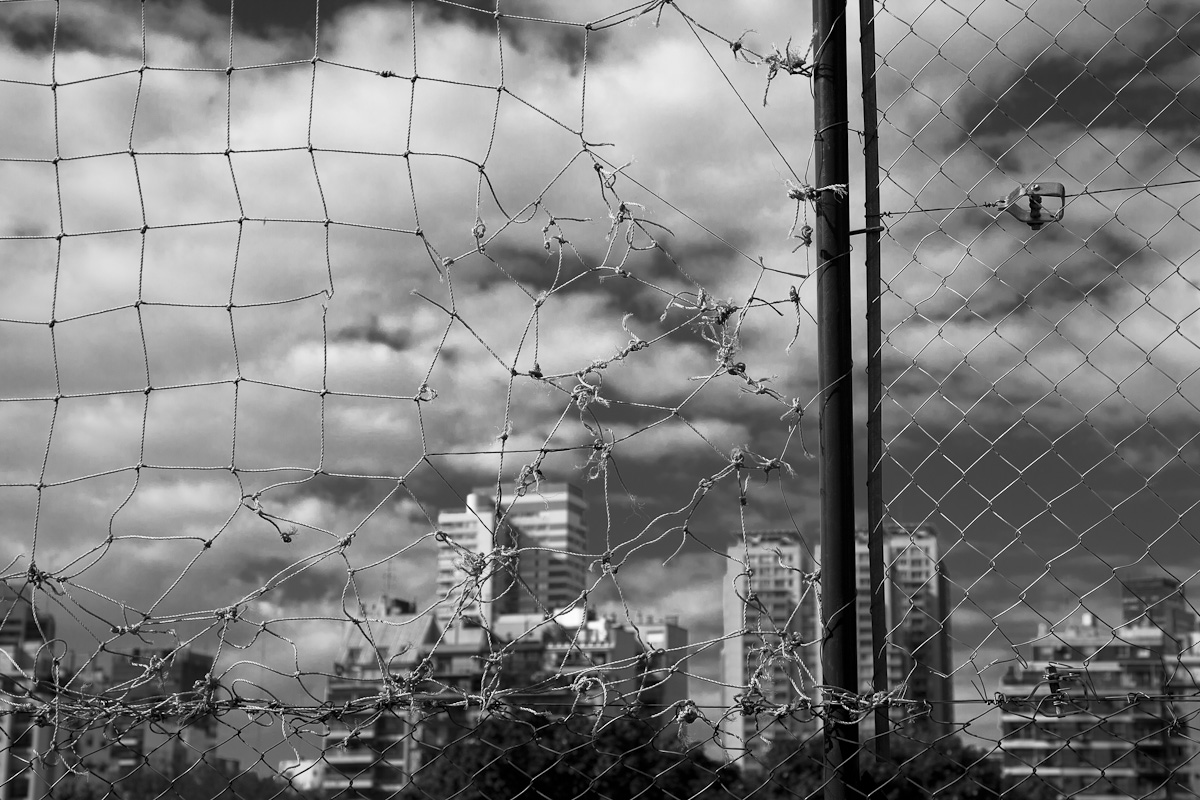
My memory of Buenos Aires is a network grid of memory strands that over time have loosened and been refastened into a random pattern of time and place. My experience once had the logical clarity of an 18-year old – everything aligned perfectly to a limited worldview. There are things that I see, smell, and hear that bring back sharply the reality I once was part of.

Photo of netting


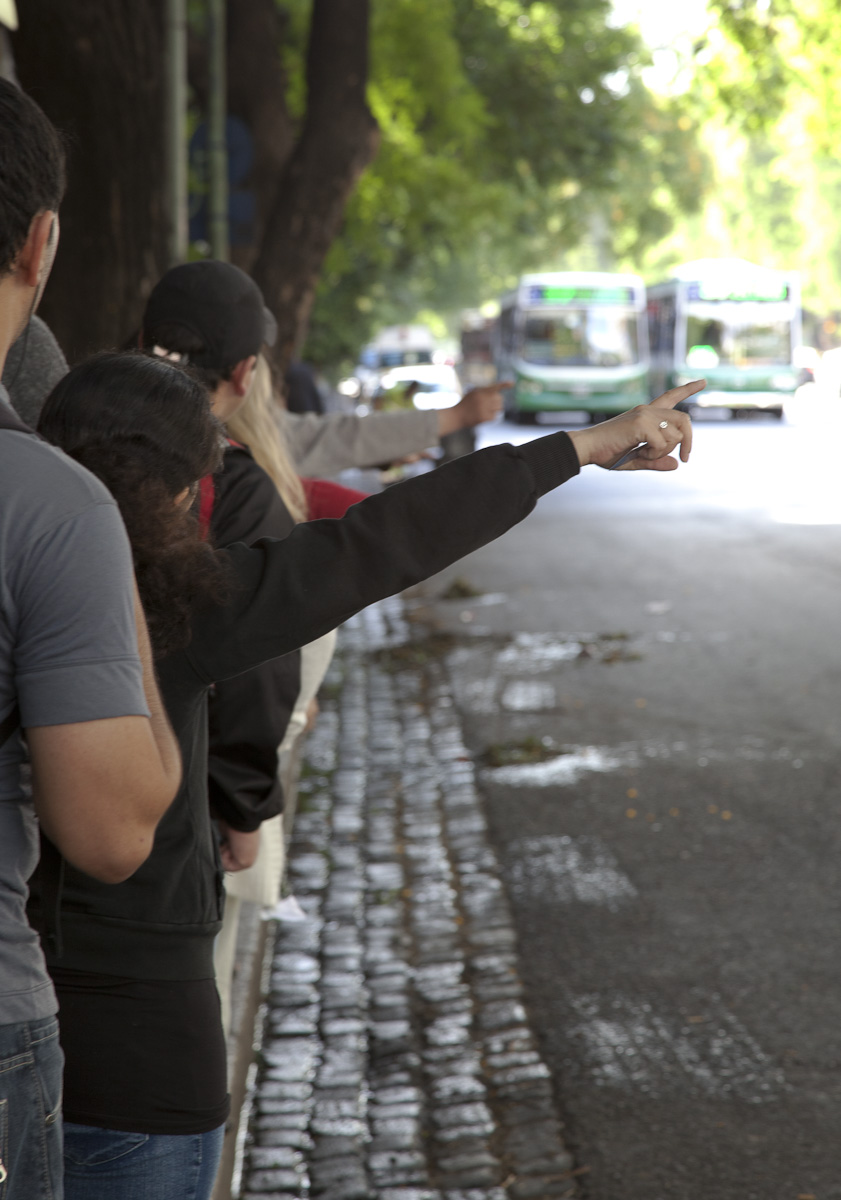
Voices, conversations floating in the street…intonations… are like the melody of an old hit song that suddenly plays on the radio…the broken strand is repaired …not exactly squared up, but still there. Simple gestures….calling for a bus to stop… playback a way of life.

Many of the photographs that I captured today are simply reaffirmations of an experience I took for granted, thought I understood…you get older and you realize how little you once knew and how little you know now. These images are apparitions – the ghosts of time past.

Posted in Fine Art Photography, Uncategorized | Tagged , , , | 4 Comments

Returning – photography takes me back


On my way….I am on a trip I’ve been trying to make for 33 years – back to Argentina where I spent my childhood and youth; where I first became enamored with photography. Its a place where I discovered I had an affinity for making images – hundreds of hours spent in darkrooms watching blank paper dissolve magically into photographs – finding success in something I felt a passion for. This trip is about understanding my past, the cultures I’ve crossed over, and the foundation the perspectives that I have today.

I am going to use photography to re-encounter Argentina and to interpret my experience. For a while, this blog will serve as a space where I can explore, and perhaps get responses on, the role of photography in helping us come to terms with life events and experiences.

I am not planning on making yet another travelogue here, (that is what Facebook is for!), rather my intent will be to reflect on how making photographs helps us come to new understandings and what it is about the process of making and working with images that is meaningful.

Posted in Creativity and Photography, Fine Art Photography, Uncategorized | Tagged , , , | 1 Comment

Revolution in a Photograph – Aliaa Magda Elmahdy and Ai Weiwei


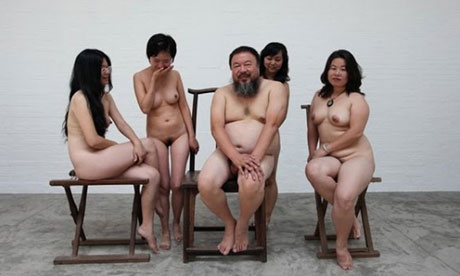
Two photographs published by artists of themselves have generated a great deal of controversy recently. The geographic and cultural distance between the two artists is worlds apart, but their response to repression through a photograph and it’s distribution through the Internet is remarkable. Photography and social media provided a unifying venue that transcended regional and cultural boundaries. Aliaa Magda Elmahdy (مذكرات ثائرة.), an Egyptian art student and Ai Weiwei  (Ai Weiwei investigated over nude art | Art and design | The Guardian) published portraits of themselves unclothed. Both artists revealed their bodies in photographs as statements against political and cultural repression; Elmahdy tells her society to”rid yourselves of your sexual hangups before you direct your humiliation and chauvinism and dare to try to deny me my freedom of expression”, Ai Weiwei uses his image, “One Tiger Eight Breasts”, to assert that nudity is not equivalent to pornography.

The Chinese artist Ai Weiwei poses with nude women in Beijing. Photograph: Afp/AFP/Getty Images

Although nudity and activism are common themes the images are aesthetically very different. Ai Weiwei sits comfortably in what appears to be an artist’s studio with white walls and concrete floor, smiling, surrounded by four also nude women, some laughing others serious, warm and soft studio light wrapping the group. Ai Weiwei is the focal point of the composition and his gaze engages the camera directly. It’s an arrangement reminiscent of a figure drawing class, as if the models were captured during a break – the moment is informal and light-hearted.  By comparison Aliaa Magda Elmahdy’s self-portrait is rather starkly lit by a point-and-shoot camera flash, the direct contrasty light reveals every detail, but flattens the space and volume of her body. The image is primarily in black and white with a ribbon in her hair and her shoes highlighted in intense red. She also wears thigh-high stockings and is standing in a straightforward way, as if she were posing for a figure drawing session, gazing above and past the waist-high camera position.

Ai Weiwei’s image has a long Western tradition behind it, it references a historical thread of paintings of groups, artists pictured with their models, and visual study of the figure. Given Ai Weiwei’s sophistication as an artist, is is unlikely that this is an accident. The image is controversial in China simply because the cultural values imposed by the government view nudity as immoral…. and they are not alone – there are many other countries and conservatives in the U.S. that have a shared perspective on the body.

Aliaa Magda Elmahdy skirts around some sharp edges with an image whose reference is much more contemporary. This image has social media written all over it – looks like it could be posted in a photo album at dating website…except that it has been aestheticized in post-production.

Aliaa Magda Elmahdy, “Nude Art”, 2011

The color has been removed from the image minus the color accents in the ribbon and shoes. It appears that Elmahdy is looking at herself pose in a mirror behind the camera, because she stares past the camera at something – her attention and gaze are focused. The haunting aspect of this image is that it lies somewhere between innocence and seduction; the pose and gaze are neutral –  without expression – but the adornment of the stockings, shoes, and ribbons imply otherwise. The image takes on more meaning and danger for the artist given the context of her culture in which women revealing their bodies is violently repressed. Her photograph in the context of Egyptian culture is about the repression of expression and the narrowly defined role of women, but it is also about herself – it invites the viewer to look – the image seems to say “here I am, this is me, this is the secret my clothes cover each day – it is a frank and forthright image.

In the United States the consequences for both artists publishing nude images of themselves would be only personal in nature – the media would have never noticed and the lack of sexual depiction makes the images tame. It is the context of where the images came from – who created them and why – that makes them controversial and attention-grabbing, not their content. Both artists took on considerable risk in publishing these images; Ai Weiwei could be charged with publishing pornography and imprisoned, Aliaa Magda Elmahdy faces public humiliation, shunning, or much worse….

The power of an individual photograph to provoke strong reactions has been verified with the controversy surrounding these images. In one culture they are near-harmless, in another, revolutionary. The proliferation of low cost cameras, the worldwide reach of the Internet, and the global community participating in social media gives these images voice and significance.

Posted in Fine Art Photography, Photo Criticism, Photographic Technology, Uncategorized | Tagged , , , , , , , , | 10 Comments

Teaching Photography As If Nothing Has Changed


We teach photography as if nothing has changed; as if silver had never been swapped out for pixels. If fact, that is how we act, as if the silver grains on film frames were switched with pixels on sensors with no difference. We teach as if silver and pixels are two versions of the same thing, but they are not. We’ve changed the language, sometimes calling an exposure a “capture”, but we haven’t changed our approach.

I have a “full frame” camera sensor, which I was ecstatic to finally acquire. But it is a pleasure born from familiarity. We haven’t asked ourselves what the implications of pixels are. We have not acknowledged that the camera, as a device, has become more complex and interactive; that the image itself has become more liquid than fixed. We create new tools to manage the multiplicity of our digital captures without asking ourselves what it means to be able to shoot,  file, and recall thousands of images; to categorize the images and delete them at will.

These seem to be key questions that we must explore, that there are implications to the way we teach and learn photography, as well as to how we communicate and express concepts through photography. For example, how does the now hyper-precise control that a photographer has in post-production impact the initial image capture? Should HDR techniques become standard practice – is this our intent to create all images with detailed contained in lightest of highlights and the darkest of shadows – does this now define a well-exposed image? Some devices simultaneously create HDR exposures, so doesn’t this impact our expectations of the quality of the image? There seems to be a great number of considerations that we ignore.

A camera just as easily records high-definition motion as it does a high-resolution still image. The photographers we create today in higher education must be adept at both composing a moment of time and recording moments over time. But we continue to teach them only depth of field and aperture, shutter speed and motion. The camera has increased in capability, but the education has not grown with it – we treat video concepts and motion techniques as a supplement. Isn’t the red record button on our cameras now a third function, equal to the shutter and aperture settings?

…to be continued…

Posted in Photographic Technology, Uncategorized | Tagged , , , , , | 2 Comments

Scottsdale, Arizona – city of walls


Posted in Fine Art Photography | Tagged , , | 1 Comment

Transformative Moments


A photograph transforms a moment in time into a window through which the invisible becomes visible.

…inspired by Henri Nouwen

Posted in Creativity and Photography, Photographic Technology, Uncategorized | Tagged , , , | 2 Comments

Managing the Image


Sorting through the catalog

The images that a photographer accumulates over time are an extensive collection of creative acts, or at least, partial expressions of ideas. Any photographer who makes images for a living…or to live…creates thousands of tiny images viewable as negatives in plastic sheets or 8 x 10in contact prints.  The process of archiving and cataloging acetate negatives requires great care; maintaining particular environmental conditions and having a system of cataloguing images are basic necessities if the photographer plans on retrieving and reprinting.  Many photographers go so far as to log camera exposures, printing exposures, and any chemical treatments applied to the print.  A contact sheet was at least marked with selected images and personal annotations. More adventurous souls might even cross-reference their negatives, rather than simply file them chronologically.  Regardless of the system, viewing and retrieving images on acetate rolls of film is an arduous task with many built in obstacles.

Contact sheets or negative files are usually stored in binders or hanging folders.  Since they come on strips, they are usually cut down to five or six images per strip and placed along others from the same roll; the basis for initial cataloguing is per roll and is therefore chronological. What it comes down to is that, unless the photographer plans to cut up each individual frame, with acetate negatives there is just one way to view the images.  Even going through the task of slicing down to each frame, the photographer is still bound by being able to select only one topic. While there are duplicating filing techniques that allow some flexibility, it is clear how cumbersome and complex the retrieval process can be.  Viewing sequences of images is further hindered by how the images were exposed on the roll of film; the photographer is forced to first consider each roll and may only view each sheet separately. The exposure is always associated with those made before and after it, unless the negative is filed on it’s own.  There is way of thinking in how the photographer files those images away in their head that completely unravels with digital photography.

Digital technology allows a photographer to have one image viewable through an unlimited number of categories using keywords that are tagged to the image. Within those categories, the images may be sorted a variety of ways, or simply manually put in sequence.  A photographer has at their fingertips an immediate way to sort, select, and view thousands of images.  An image can be instantly associated with another, exposed decades apart, by sharing a common characteristic defined by the photographer.  The result is a previously unheard of level of control over how the images are viewed and combined.

The impact of the digital catalog, other than ease of access, is that of association.  Like GIS maps graphically depict and apply a variety of criteria to a geographic area, linkage of images through keywords allows a photographer to discover new associations and trends in their work.  Over time this can lead to a deeper understanding of the images, create a pool of images for montage, or allow a photographer to experiment with very personal ways of threading images together.

Posted in Creativity and Photography, Photographic Technology | Tagged , , , | 3 Comments

Creating the Image –


Previewing the options

Photographers used Polaroids for many years to preview an exposure.  It wasn’t instantaneous, but it gave a quick two-dimensional rendering of the scene. Unfortunately that technique was expensive and was most suitable in a studio situation with a large format camera. The ability to instantly see your image after it is recorded is a great advantage of digital photography and it changes the way a photographer conceives their final image. The use of the Polaroid was the precursor to the LCD panel that is standard on most digital cameras today; the use of Polaroids informed the design of the user experience on digital cameras.  The invention of digital cameras was informed by 150 years of user feedback on camera equipment.

Instant review gives the photographer in-field feedback on how the image is coming together.  It’s not just a matter of evaluating exposure and color.  The photographer can see how effective their composition is while they are still in the act of creation.  Just like a painter would respond to each stroke of paint on a canvas, the digital photographer has the option of responding to the image in-situ. Unlike the painter, whose strokes are not erased easily, the digital image can be deleted and retaken.  In fact what happens is that the photographer is able to engage the process of creation in a continuous transaction between what is being visualized and what is being captured on the CCD panel.

Previously, one of the distinct characteristics of photography was that there was not a continuous dialogue between the artist’s gesture and the result – the photographer was operating blind to the actual record of the light on the film.  The photographer could imagine what they were capturing as they fired the shutter, but they were, in a sense, liberated from having to immediately evaluate the result.  The gesture of the photographer was restricted to things they could see through the viewfinder, such as the focus, edges of the composition, and how long they chose to make the exposure. But the liberation came from the fact that a photographer had no choice but to shoot away, encouraging them to move quickly, try different perspectives, and a variety of exposures. The romantic image of the photographer seems to jump from the slow judicious and meticulous image set-up of Ansel Adams to the fashion photographer firing away with a camera machinegun at their subject.

There is an inevitable impact on the creative process if the photographer chooses to preview (or post-view) exposures.  There is the interruption in the creative process as the photographer switches to evaluation mode.  There is an immediate comparison between what the photographer might have envisioned the image to look like, to what it actually looks like on the small LCD panel.  That aside, the photographer is likely to engage themselves in a Q & A session of “what if’s”.  What if the exposure were darker?  Framed differently?  Focused differently?  And so on.

When a photographer begins to engage the image evaluation process, they leave the creative act momentarily.  Think of the photographer’s change in relationship to their subject (whether person or object):  their gaze shifts down to the LCD panel and away from their subject –  the visual and psychological connection is broken.  The rapport with the subject is disrupted and temporarily suspended. Once done, the photograph shifts back into “create” mode.  If we make the inevitable comparison to painting, there is quite a difference, because the artist is continuously engaged visually with the canvas, constantly shifting their gaze from subject to depiction, or if not, reacting directly to each mark.  The digital image is a separate entity; it is in a handheld box and exists alone in an ephemeral collection of electrical charges, separate from the subject, author, and as yet not an object.  The camera is an in-between device, temporarily holding a bank of images waiting to be evaluated, transferred, adjusted, combined, then, perhaps printed. There’s a long way between the moment of recording and the object.

Recording vs. Making an Exposure

Digital cameras don’t really make an exposure, rather they make a scan of the light focused through the lens.  A silver negative is the result of an organic process; the light has a physical impact on the state of a frame of the emulsion-coated acetate. The state of the charge-coupled device that is making the scan records information about the intensity of light, shadow, and color, and then passes that code to the memory card where it is stored. The digital image does not exist as an object until it is printed; until then it is a code being stored on a hard drive and displayed on a monitor – a code that can be manipulated in an infinite number of ways.

The recording aspect of digital photography makes the medium more process-oriented then object oriented.

Posted in Creativity and Photography, Photographic Technology | Tagged , , , | 2 Comments

Knowing the possibilities of digital manipulation


Understanding the characteristics of the photographic medium has always been essential for a photographer in order to imagine the possibilities.  A key concept for beginning photography students is arriving at a comprehension of the negative – positive process and being able to visualize the transformation of 3-D space and color into a flat black and white image.  That is still the case in digital photography, but in addition, a host of new ways that the image can be addressed by digital means opens up even more complexity.  The knowledge of the possibilities of digital manipulation influence the photographer at the time of exposure.  For example, having had the experience of digitally manipulating the tonal range of an image allows a photographer to know that they will be able to isolate certain colors and tones in post-processing.  Knowing how images can be blended influences framing.

This is also the case with silver-based photography, nevertheless, the almost limitless number of options and the ability to save and replicate the application of each process on multiple images provides a platform for conceptual development that extends the vision of the photographer at the moment of exposure.  Digital manipulation adds to the elements that the photographer might seek and, in a sense, liberates her/him from the elements of nature. When an exposure is made on film and processed, the silver crystals have a fixed response:  they darken or are dissolved.  Processing and exposure manipulation can push or pull the contrast to some extent, but when you compare this to the pixel-by-pixel adjustments possible in digital photography, there is a clear difference.  Pixels follow the rules of the programmer; they do not necessarily follow a fixed response.  For example, in digital photography a typical option in-camera is to switch back and forth between black and white and color, or to take sepia-toned exposures.  The result is that the CCD’s can be set to interpret the scene in any way that the programmer can imagine.  Now, in the infancy of digital photography, programmers mimic silver-based traditions, but what will happen in the future as digital photography separates itself from the physical limitations of silver?  The creative vision of the photographer is likely to be extended by customizing how the pixels interpret light. In the end, what defines photography is the imprint of light; the device or method used to record the imprint simply renders light differently and engages the photographer’s creative process in different ways.

Posted in Creativity and Photography, Photographic Technology, Uncategorized | Tagged , , | 1 Comment